








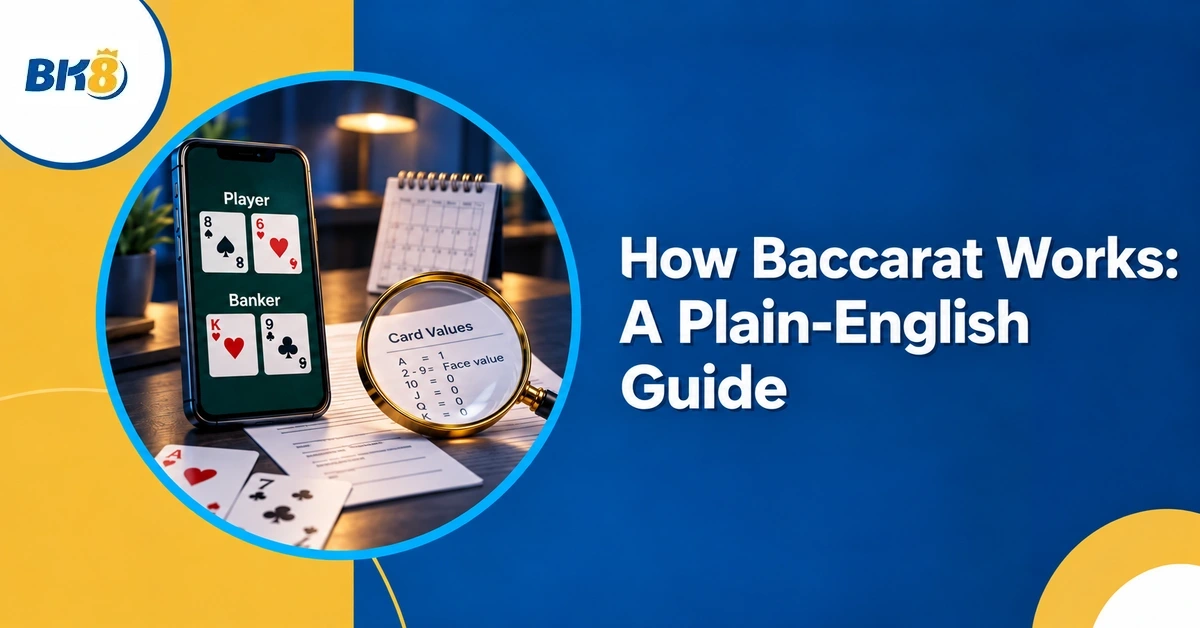
Baccarat can look complicated the first time you see a live table.
There are cards on two sides of the screen, labels saying Player and Banker, numbers appearing beside the hands, and sometimes a scoreboard filled with red and blue circles.
Then the dealer suddenly draws another card—or doesn’t.
For a beginner, it can look like there are dozens of decisions to learn.
The basic game is much simpler than that.
In the common Punto Banco-style version of baccarat, the central idea is to compare two hands:
Player
and
Banker
The winning hand is the one whose final value is closer to 9, with the game’s drawing rules determining whether additional cards are dealt.
That means learning how to play baccarat doesn’t require memorizing every advanced table feature immediately. Start with the two hands, learn how cards are valued, understand how totals work, and then add the more detailed rules afterward.
Key takeaway: Baccarat becomes much simpler once you understand that Player and Banker are the names of two hands competing to finish closer to 9.
What Is Baccarat?
Baccarat is a card game built around comparing the final values of two hands.
Those hands are called:
Player
and:
Banker
A third main result category is:
Tie
The objective is not to personally build a hand by choosing whether to take another card in the way a blackjack player might.
Instead, cards are dealt according to baccarat’s rules.
The result is determined by whichever hand finishes closer to 9, or whether the two hands finish with the same value.
What Do Player, Banker, and Tie Mean?
This is usually the first thing beginners need to understand.
Player
Player is the name of one baccarat hand.
Banker
Banker is the name of the other hand.
Tie
A Tie occurs when the Player and Banker hands finish with the same final value.
The words Player and Banker can be misleading because they sound like they refer to people.
In baccarat, it’s easier to think of them simply as:
Hand A = Player
Hand B = Banker
Once that clicks, the table immediately becomes less intimidating.
Beginner tip: Don’t think “I am the Player.” Think “Player is one of the two hands on the table.”
What Is the Basic Goal of Baccarat?
The goal is to identify the result of the comparison between Player and Banker under the game’s rules.
The hand closer to 9 wins.
But baccarat totals don’t work exactly like ordinary addition because only the final digit matters when a total reaches 10 or more.
For example:
7 + 2 = 9
The hand value is 9.
But:
7 + 6 = 13
The baccarat hand value is 3.
And:
8 + 7 = 15
The hand value is 5.
You can think of it as dropping the tens digit.
How Are Baccarat Cards Valued?
The card-value system is straightforward.
| Card | Baccarat Value |
|---|---|
| Ace | 1 |
| 2 | 2 |
| 3 | 3 |
| 4 | 4 |
| 5 | 5 |
| 6 | 6 |
| 7 | 7 |
| 8 | 8 |
| 9 | 9 |
| 10 | 0 |
| Jack | 0 |
| Queen | 0 |
| King | 0 |
The most important thing to remember is:
10s and face cards are worth zero.
Aces are worth one.
Everything from 2 through 9 uses its face value.
How Do You Calculate a Baccarat Hand?
Let’s use a few examples.
Example 1
Player receives:
4 + 5
Total = 9
Final hand value = 9
Example 2
Banker receives:
8 + 6
Total = 14
Final hand value = 4
Example 3
Player receives:
King + 7
King = 0
So:
0 + 7 = 7
Final hand value = 7
Example 4
Banker receives:
9 + 8
Total = 17
Final hand value = 7
Once you understand this “last digit” system, reading baccarat hands becomes much faster.
Why Is 9 the Highest Baccarat Hand?
Baccarat hand values run from 0 through 9.
When the total goes beyond 9, only the final digit is used.
So a hand totaling 19 is still valued at 9.
A hand totaling 18 is valued at 8.
A hand totaling 10 is valued at 0.
There is no baccarat hand value of 10, 11, or 12.
That’s why 9 is the highest possible final value.
What Is a Natural in Baccarat?
A natural generally refers to an opening two-card hand totaling 8 or 9.
For example:
5 + 4 = 9
or:
6 + 2 = 8
These opening totals are important because they affect whether additional cards are drawn under the game’s rules.
For beginners, however, the main thing to remember initially is:
8 or 9 on the first two cards is a particularly important opening total.
You can learn the detailed drawing sequence after the basic scoring system makes sense.
Who Decides Whether a Third Card Is Drawn?
This is one of the biggest differences between baccarat and blackjack.
In blackjack, the player can make decisions such as hit or stand.
In the common baccarat format, the Player and Banker hands follow established drawing rules.
The user doesn’t simply decide:
“Give Player another card.”
or:
“Banker should stand.”
The game rules determine what happens.
This is one reason baccarat can actually be easier for beginners than it first appears.
Do Beginners Need to Memorize the Third-Card Rules?
Not immediately.
Understanding the rules eventually is useful, especially if you want to know why the dealer takes a particular action.
But you don’t need to memorize an entire third-card chart before understanding your first baccarat round.
A better learning order is:
Player and Banker → card values → hand totals → naturals → third-card rules
Trying to learn the third-card table first makes baccarat look much harder than necessary.
How Does the Player Third-Card Rule Work?
In the standard game structure, the Player hand’s drawing behavior depends on its total, subject to natural-hand rules and the game’s established procedures.
Once the Player action is resolved, the Banker hand may follow a more detailed drawing rule that can depend on both its own total and, in certain situations, the Player’s third card.
This is the part of baccarat that beginners often find intimidating.
The good news is that the game or dealer handles these rules automatically.
Your job as a learner is first to understand why an additional card may appear, not necessarily to memorize every combination immediately.
Why Is the Banker Third-Card Rule More Complicated?
Because the Banker’s drawing rule can depend on more information.
The Banker’s existing total matters.
In some circumstances, the value of the Player’s third card matters too.
That’s why baccarat rule charts often look more complicated on the Banker side.
This complexity happens behind the basic experience.
The central result remains easy to understand:
Which final hand is closer to 9?
What Happens During a Typical Baccarat Round?
A standard round can be understood in stages.
Step 1: The Round Opens
The table prepares for the next hand.
Step 2: Player and Banker Receive Cards
Two initial cards are normally dealt to each hand.
Step 3: Initial Totals Are Calculated
The baccarat values determine each hand’s total.
Step 4: Drawing Rules Are Applied
If required, an additional card is dealt according to the rules.
Step 5: Final Values Are Compared
The hand closer to 9 is the winning hand.
Step 6: The Result Is Displayed
The table resets for another round.
That’s the basic baccarat cycle.
What Does a Tie Mean in Baccarat?
A Tie occurs when Player and Banker finish with equal final hand values.
For example:
Player = 7
Banker = 7
The result is a Tie.
Tie is therefore not another hand being dealt.
It’s the outcome created when the two existing hands have matching final values.
This distinction becomes useful when reading baccarat tables and scoreboards.
Player vs Banker: What’s Actually Different?
Both are hands.
The main difference comes from how the drawing rules operate and how the table treats the result categories.
From a beginner’s perspective:
| Player | Banker |
|---|---|
| One baccarat hand | The other baccarat hand |
| Receives cards | Receives cards |
| Has defined drawing rules | Has defined drawing rules |
| Final value compared with Banker | Final value compared with Player |
| Name doesn’t mean “you” | Name doesn’t simply mean “casino” |
The terminology sounds more complicated than the underlying concept.
Why Does Banker Sometimes Have a Commission?
In traditional baccarat structures, Banker-related payouts can involve commission because of the underlying characteristics of the Banker result and drawing rules.
The exact payout structure should always be checked on the specific table you’re using.
Different baccarat variants can present payout conditions differently.
Don’t assume that because you’ve seen one baccarat table, every other version uses exactly the same payout structure.
The table rules are the correct place to verify this.
What Is Live Baccarat?
Live baccarat takes the baccarat rules and presents them through a real-time dealer table.
Instead of seeing only digital cards, viewers can watch a dealer physically manage the game through video.
The interface then displays:
Player
Banker
cards
hand values
results
and other relevant table information.
Live Baccarat vs Digital Baccarat: What’s the Basic Difference?
| Live Baccarat | Digital Baccarat |
|---|---|
| Human dealer | Software presentation |
| Real-time video | Digital graphics |
| Physical cards/table | Digitally represented cards |
| Table-controlled pace | Often faster software pacing |
| Broadcast-like | Game-like |
| Streaming connection important | Usually less video-dependent |
The core baccarat rules can remain familiar while the presentation changes significantly.
Is Live Baccarat Harder for Beginners?
Not necessarily.
Some beginners may actually find it easier because they can watch the dealer move through each stage of the round.
The dealer provides visual structure.
Cards appear physically.
Player and Banker areas are clearly separated.
The result is displayed.
Digital baccarat can use a more compact interface and a different pace.
Neither format is universally easier.
Can You Play Baccarat on Mobile?
Mobile platforms can support baccarat, including live dealer formats, when the casino platform and device are compatible.
On smartphones, good interface design becomes particularly important.
Player and Banker should remain visible.
Cards should be readable.
Controls shouldn’t cover the table.
What Is a Baccarat Scoreboard?
Live baccarat interfaces often display previous results visually.
These displays can use colored marks or structured “roads” to organize historical outcomes.
For a beginner, the most important thing to understand is:
the scoreboard records previous results.
It doesn’t change the rules of the next hand.
Later in this Baccarat cluster, we’ll cover the scoreboard and common baccarat roads separately because that topic deserves its own explanation.
Can Baccarat Scoreboards Predict the Next Hand?
No scoreboard can provide certainty about the next outcome simply because it displays previous results.
Humans are naturally good at seeing patterns.
A sequence might look like:
Banker → Banker → Player → Banker → Player
and viewers may try to interpret what should come next.
But the scoreboard is fundamentally historical information.
A baccarat scoreboard tells you what happened. It does not guarantee what happens next.
This distinction is particularly important for beginners.
What Are Baccarat Side Bets?
Some baccarat tables can include additional options beyond the main Player, Banker, and Tie outcomes.
The exact availability and rules depend on the specific table or variant.
Beginners don’t need to start there.
Learn the core game first.
Once Player, Banker, Tie, card values, and drawing rules make sense, additional table features become easier to understand.
Starting with every possible side option at once creates unnecessary complexity.
What Is the Easiest Way to Learn Baccarat?
Use five stages.
Stage 1: Learn the Two Hands
Player and Banker.
Stage 2: Learn Card Values
Ace = 1.
2–9 = face value.
10/J/Q/K = 0.
Stage 3: Learn Hand Totals
Keep only the final digit when the total reaches 10 or more.
Stage 4: Understand the Result
The hand closer to 9 wins; equal final values create a Tie.
Stage 5: Learn Drawing Rules
Only after the first four concepts are comfortable.
This approach makes baccarat much less intimidating.
Baccarat vs Blackjack: Which Is Easier to Learn?
They require different kinds of knowledge.
| Baccarat | Blackjack |
|---|---|
| Player/Banker comparison | Player vs dealer |
| Drawing rules largely predetermined | Player decisions matter |
| Goal is closer to 9 | Goal centers around 21 |
| Fewer active decisions | Hit/stand and other actions |
| Third-card rules can look complex | Strategy decisions add complexity |
Some beginners find baccarat easier because there are fewer active decisions.
Others find blackjack’s objective more familiar.
The better starting point depends on how someone prefers to learn.
Baccarat vs Dragon Tiger: What’s Different?
Dragon Tiger simplifies the card comparison further.
One card is generally dealt to each of two sides.
Baccarat uses hands that can contain additional cards according to its drawing rules.
So Dragon Tiger may be visually simpler.
Baccarat provides a slightly deeper rule structure while remaining relatively straightforward once card values are understood.
Should You Memorize Baccarat Patterns?
Don’t confuse historical patterns with game rules.
Learning:
card values
drawing rules
hand totals
is learning baccarat.
Memorizing a visual sequence of previous Player and Banker results is studying history.
Those are not the same thing.
Previous outcomes shouldn’t be treated as guarantees about the next hand.
Does Knowing Baccarat Rules Guarantee Better Results?
No.
Understanding the rules helps you know what you’re watching and why the dealer takes certain actions.
It doesn’t make future outcomes certain.
Knowledge improves comprehension.
It doesn’t turn baccarat into a predictable sequence.
This distinction is fundamental to responsible casino education.
A Note About Risk
Understanding the rules doesn’t make the next result certain. A polished interface or familiar game name doesn’t establish a website’s trustworthiness, and gambling can lead to financial loss.
Why Should Beginners Set Limits Before Playing?
Because understanding the rules doesn’t remove uncertainty.
If choosing to participate, decide beforehand:
how much time you want to spend
what entertainment budget applies
when you will stop
Don’t increase a budget because previous hands didn’t produce the result you expected.
And don’t assume one side becomes “due” after a sequence of the other.
The rules explain the game.
They don’t justify chasing outcomes.
A Note About Risk
Understanding the rules doesn’t make the next result certain. A polished interface or familiar game name doesn’t establish a website’s trustworthiness, and gambling can lead to financial loss.
Beginner Baccarat Checklist
Before moving beyond the basics, make sure you can answer:
What are Player and Banker?
What is a Tie?
What are face cards worth?
What is an Ace worth?
What happens when a hand totals more than 9?
What is a natural 8 or 9?
Who determines whether another card is drawn?
What does the scoreboard represent?
If those concepts make sense, you’ve already learned most of what you need to follow a basic baccarat round.
The Main Point
Player and Banker are the names of two hands. The final value closer to 9 wins; equal values mean a Tie. The scoring rules explain the current hand, but they don’t guarantee what happens next.
Frequently Asked Questions
How do you play baccarat?
Baccarat compares Player and Banker hands. Cards have baccarat values, and the final hand closer to 9 wins according to the game’s drawing rules. Equal final values produce a Tie.
What is Player in baccarat?
Player is the name of one of the two main baccarat hands. It doesn’t simply mean the person playing the game.
What is Banker in baccarat?
Banker is the name of the other primary baccarat hand. It doesn’t simply refer to the casino operator.
What does Tie mean in baccarat?
Tie means the Player and Banker hands finish with the same final value.

Passionate about the thrill of slots and casino gaming, John Paul Cuizon is a dedicated enthusiast with a keen interest in slot machine mechanics, strategies, and the latest trends in the gaming industry. Whether it’s classic fruit machines, modern video slots, or high-stakes progressive jackpots, John Paul enjoys exploring the exciting world of slot games.