








If you’re learning baccarat, Player, Banker, and Tie are three of the first terms you’ll encounter.
Player and Banker are the two hands being compared.
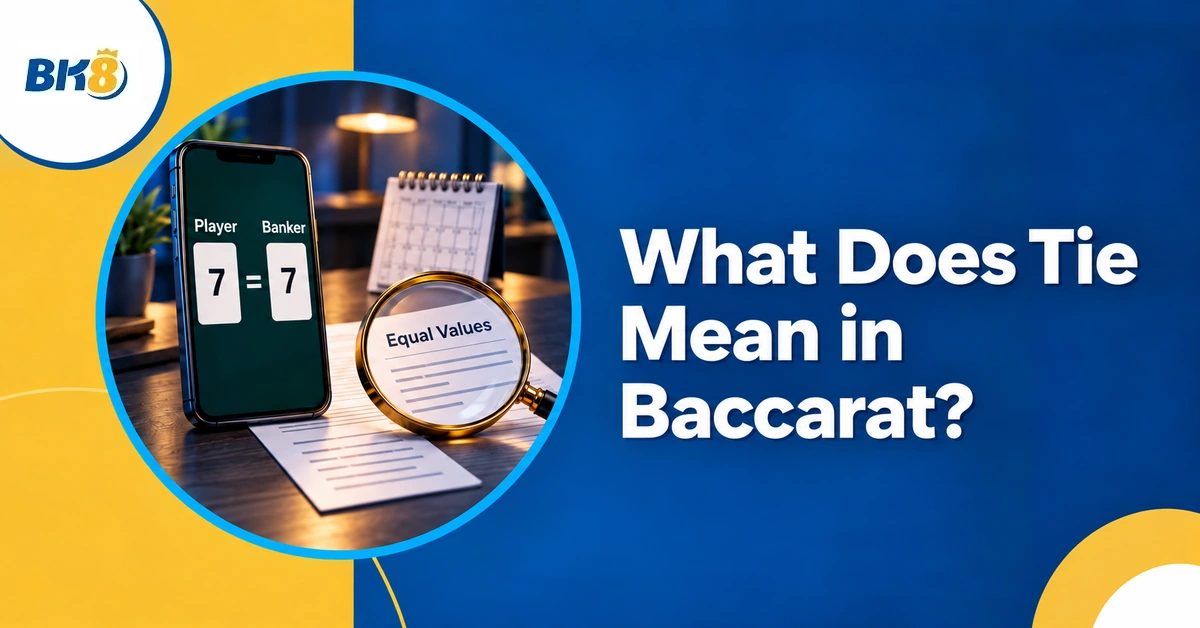
A Tie happens when both hands finish with the same baccarat value.
For example:
Player = 7
Banker = 7
The result is a Tie.
That’s the basic concept.
Quick answer: A Tie in baccarat means the final Player and Banker hand values are equal.
How Does a Tie Happen in Baccarat?
Baccarat hands are valued from 0 to 9.
Cards 2 through 9 use their face values, Ace is worth 1, while 10, Jack, Queen, and King are worth 0.
When a total reaches 10 or more, only the final digit counts.
For example:
Player: 4 + 3 = 7
Banker: 9 + 8 = 17 → 7
Because both final values are 7, the result is a Tie.
Is Tie a Third Baccarat Hand?
No.
This is an important beginner distinction.
There aren’t three competing hands called Player, Banker, and Tie.
There are only two central hands:
Player
Banker
Tie describes the result when those two hands finish with equal values.
Player vs Banker vs Tie
| Result | What It Means |
|---|---|
| Player | Player hand finishes closer to 9 |
| Banker | Banker hand finishes closer to 9 |
| Tie | Both hands finish with the same value |
This simple table explains most of what beginners need to understand before exploring the more detailed baccarat rules.
Does a Tie Mean the Round Is Replayed?
A Tie is a completed baccarat result.
It isn’t simply an unfinished round because neither side won.
The exact treatment of different table selections and payouts should always be checked in the rules of the specific baccarat game being used.
This matters because different baccarat variants can have different table conditions.
Is a Tie the Same in Live Baccarat?
The basic meaning remains the same.
In live baccarat, a real dealer handles the cards while the game is streamed to the user’s device.
If Player and Banker finish with equal values, the result is a Tie.
The main difference between live and digital baccarat is presentation—not the basic meaning of the term.
Why Is the Tie Area Usually Easy to Notice?
Casino interfaces need Player, Banker, and Tie to be visually distinguishable.
A beginner may therefore notice the Tie option before fully understanding what it means.
Don’t interpret visual prominence as information about what will happen next.
The interface design helps users identify the available result categories.
It doesn’t predict them.
Can Previous Ties Predict Another Tie?
No.
Previous baccarat results show what already happened.
A scoreboard may display several Player, Banker, or Tie outcomes, but those historical results don’t provide certainty about the next hand.
A baccarat scoreboard records history; it isn’t a schedule of future results.
This distinction becomes especially important once beginners start noticing apparent patterns.
What Should Beginners Learn After Understanding Tie?
Once Player, Banker, and Tie make sense, the next useful topics are:
baccarat card values
how hand totals work
natural 8 and 9
third-card rules
baccarat scoreboards
Those concepts explain why the final Player and Banker values become what they are.
Does Understanding Tie Make Baccarat Easier?
Yes, because it removes one of the first terminology barriers.
A beginner can simplify the game to:
Player higher → Player result
Banker higher → Banker result
same value → Tie
The more detailed drawing rules determine how those final values are reached, but the basic comparison remains straightforward.
A Note About Risk
Understanding the rules doesn’t make the next result certain. A polished interface or familiar game name doesn’t establish a website’s trustworthiness, and gambling can lead to financial loss.
The Main Point
A Tie is simply an equal final value. It isn’t a third hand, and a previous Tie doesn’t tell you what the next result will be.
Frequently Asked Questions
What does Tie mean in baccarat?
A Tie occurs when Player and Banker finish with the same final baccarat hand value.
Is Tie a third hand in baccarat?
No. Player and Banker are the two hands. Tie describes an equal final result between them.
Can both Player and Banker have 9?
Yes. If both final hands have the same value, including 9 where applicable under the completed round, the result is a Tie.
Does a previous Tie make another Tie more likely?
Previous results don’t provide certainty about the next baccarat outcome.
Is Tie different in live baccarat?
The basic meaning is the same. Live baccarat changes the presentation by using a real-time dealer and table.
Should beginners learn Tie before third-card rules?
Yes. Understanding Player, Banker, Tie, and basic card values first makes the more detailed drawing rules easier to learn.
Conclusion
A Tie in baccarat is one of the simplest concepts in the game.
There are two main hands:
Player and Banker.
If one finishes closer to 9, that hand produces the corresponding result.
If both finish with the same value, the result is a Tie.
That’s it.
Tie doesn’t mean a third hand—it means the two baccarat hands finished equal.
For beginners, understanding that distinction is an important first step before moving into card values, third-card rules, and baccarat scoreboards.

Passionate about the thrill of slots and casino gaming, John Paul Cuizon is a dedicated enthusiast with a keen interest in slot machine mechanics, strategies, and the latest trends in the gaming industry. Whether it’s classic fruit machines, modern video slots, or high-stakes progressive jackpots, John Paul enjoys exploring the exciting world of slot games.